
The Definitive Limited Guide for Secrets of Strixhaven
Secrets of Strixhaven is one of the most mechanically rich limited environments in recent memory. Five rival colleges, each with a unique keyword mechanic, compete for dominance across sealed pools and draft tables. The difference between a 1-3 and a 3-1 record often comes down to understanding which cards matter most in your college and how to unlock their synergies.
This guide breaks down all five colleges in depth: their core mechanic, the cards you should prioritize, the synergies that win games, and the concrete game plans you should be executing. Whether you are cracking six packs for sealed or navigating a draft pod, this is everything you need to dominate Secrets of Strixhaven limited.
We also cover the Mystical Archive bombs you should pray to open, and close with sealed-specific tips for this format.
Silverquill (White-Black) — Targeted Removal, Massive Payoffs
How Repartee Works
Repartee is Silverquill's signature mechanic. Whenever you cast an instant or sorcery that targets a creature, your Repartee abilities trigger. This means removal spells, combat tricks, and even pump spells aimed at your own creatures all generate extra value. The key insight: in Silverquill, every targeted spell is doing two jobs at once.

Top 5 Cards to Build Around
- Silverquill, the Disputant — The mythic Elder Dragon is absurd. A 4/4 flying vigilance for four mana is already ahead of the curve, but giving ALL your instants and sorceries casualty 1 means every removal spell generates a copy. If you have even two Inkling tokens on board, you are copying two spells per turn cycle. First-pick, build-around bomb.
- Harsh Annotation — Two mana to destroy any creature is the best removal spell in the entire set at common/uncommon. Yes, your opponent gets a 1/1 flying Inkling token, but you just killed their 5-drop for two mana. In Silverquill specifically, this also triggers all your Repartee creatures since it targets. Slam pick at uncommon.
- Moment of Reckoning — Choose up to four modes, and you can repeat modes: destroy a nonland permanent OR return a creature from your graveyard. In practice, this means you can wipe three threats and reanimate your best creature, or destroy four things. Seven mana is a lot, but this card wins the game when it resolves.
- Scolding Administrator — A 2/2 menace at uncommon that creates an Inkling token whenever Repartee triggers. Cast Rapier Wit targeting an opposing creature? You tap their creature, stun it, AND get a 2/1 flying Inkling. That is three effects from one two-mana spell.
- Inkling Mascot — The common mascot creature is a 2/2 that gains flying and surveil 1 whenever Repartee triggers. The surveil smooths your draws, and the flying makes it a genuine threat. In a deck with 8-10 targeted spells, this creature attacks for 2 in the air almost every turn.
Game Plan
Silverquill wants to play aggressive midrange. Curve out with efficient creatures like Imperious Inkmage (3/3 vigilance with ETB surveil 2) and Inkling Mascot, then use targeted removal to simultaneously clear blockers and trigger Repartee. Last Gasp giving -3/-3 for two mana is your bread-and-butter removal that also triggers every Repartee creature you control.
The dream curve is turn 2 Inkling Mascot, turn 3 Scolding Administrator, turn 4 Silverquill Charm targeting something. You just made an Inkling, gave the Mascot flying, surveil'd, and still have two strong attackers. Silverquill games snowball fast when your removal doubles as a token engine.
Key Synergies
- Rapier Wit + Repartee creatures: Rapier Wit costs just two mana to tap a creature and add a stun counter. It targets, so it triggers all your Repartee abilities. At instant speed during combat, you can tap down a blocker while creating Inklings and gaining flying on your attackers.
- Silverquill Charm flexibility: Silverquill Charm gives +2/+2 counters (targets your creature, triggers Repartee), exiles a creature with power 2 or less (targets, triggers Repartee), or drains 3 life. Every mode except the drain is a Repartee trigger.
- Render Speechless as double duty: Render Speechless strips a card from their hand AND puts 2 counters on one of your creatures. The counters target, so Repartee fires. You are disrupting their hand while building your board.
Prismari (Blue-Red) — Go Big or Go Home
How Opus Works
Opus triggers whenever you cast an instant or sorcery. Every Opus creature has two tiers of effect: a base ability that fires on any spell, and an enhanced version that fires when you spend 5 or more mana on the triggering spell. This creates a natural tension: do you cast two small spells for two base triggers, or one big spell for one enhanced trigger? Usually, the enhanced triggers are so powerful that going big is correct.

Top 5 Cards to Build Around
- Prismari, the Inspiration — A 7/7 flyer for seven mana that gives ALL your instants and sorceries Storm. This is quite literally the most powerful limited card in the set. Cast a 5-mana removal spell with two other spells in the turn, and you get three copies. If you cast two spells before the third, the Storm count is 2. This card turns every spell into a game-ending play.
- Stress Dream — Five damage to a creature plus filtering the top 2 cards of your library. This hits almost every creature in the format, and the card selection helps you find your next big spell. Premium uncommon removal that you should always play.
- Spectacular Skywhale — A 1/4 flyer that gets +3/+0 from Opus on any spell. When you spend 5+ mana, it also draws a card. So your 5-mana removal spell also turns your Skywhale into a 4/4 flyer that drew you a card. This is the uncommon that makes Prismari tick.
- Rapturous Moment — Draw 3, discard 2, add UURR. This card fuels itself — you draw three, keep the best, then have four mana to immediately cast another spell. That second spell triggers all your Opus creatures again. This is the engine card that makes Prismari's big turns possible.
- Elemental Mascot — The common mascot is a 1/4 flying vigilance that gets +1/+0 from Opus (or +3/+0 on 5+ mana). A 4/4 flying vigilance common that only asks you to cast spells you were already casting. Draft as many as you can.
Game Plan
Prismari is the slowest college but has the highest ceiling. Your first three turns should be spent developing mana and playing cheap creatures like Elemental Mascot. Treasure tokens are essential — cards that create them effectively ramp you to your 5-mana threshold one turn early.
The ideal Prismari turn looks like this: turn 5, cast a Stress Dream for 5 mana, killing their best creature. Your Spectacular Skywhale becomes a 4/4 flyer and draws you a card. Your Elemental Mascot becomes a 4/4 flying vigilance. You just killed their creature, drew a card, and now have two 4/4 flyers attacking next turn. That is what Prismari does.
Prioritize Quick Study (draw 2 for three mana) and Unsubtle Mockery (4 damage + surveil for three mana) as your common spell backbone. Heated Argument at five mana deals 6 to a creature plus 2 to its controller — it hits the 5-mana Opus threshold perfectly.
Key Synergies
- Rapturous Moment chains: Cast Rapturous Moment, draw 3, discard 2, add UURR. Immediately use that mana to cast another spell. All Opus creatures trigger twice in one turn. If the second spell costs 5+, the enhanced triggers fire too.
- Prismari Charm versatility: Prismari Charm gives you surveil 2 + draw, OR 1 damage split among targets, OR bounce a nonland permanent. The first mode triggers Opus while replacing itself. At 3 mana it does not hit the 5-mana threshold, but triggering Opus while drawing is excellent.
- Muse's Encouragement as top end: Muse's Encouragement for 5 mana creates a 3/3 flying Elemental token and surveil 2. It naturally hits the Opus 5-mana threshold, so all your Opus creatures get their enhanced triggers while you also add a 3/3 flyer to the board.
Witherbloom (Black-Green) — The Sealed Monster
How Infusion Works
Infusion checks one simple condition: did you gain any life this turn? If yes, all your Infusion abilities are active. It does not matter if you gained 1 life or 20 life — a single point turns on everything. This makes enablers like Pest tokens (which gain 1 life when they attack or die) incredibly valuable. The entire college is built around this binary switch: gain 1 life, unlock devastating effects.

Withering Curse — board wipe with Infusion

Professor Dellian Fel — planeswalker bomb
Top 5 Cards to Build Around
- Withering Curse — Without Infusion, this gives all creatures -2/-2 for three mana, which already kills most of the format's small creatures. With Infusion active, it destroys ALL creatures. That is a one-sided board wipe in most game states — gain 1 life, cast this, and you just Plague Wind'd your opponent. The best non-mythic bomb in the set.
- Professor Dellian Fel — This planeswalker does everything Witherbloom wants. +2 to gain 3 life (turns on Infusion for the rest of the turn), 0 to draw a card, -3 to destroy a creature, and -6 for a game-ending emblem. Landing this on turn 4-5 usually wins the game because your opponent cannot profitably attack into a planeswalker that gains life every turn.
- Bogwater Lumaret — This 2/2 common is secretly the most important card in Witherbloom. Whenever ANY creature you control enters the battlefield, you gain 1 life. That means every creature you play turns on Infusion for the rest of the turn. Pest tokens entering? Infusion is on. Playing your 4-drop? Infusion is on. This card single-handedly makes your entire deck work.
- Blech, Loafing Pest — A 3/4 for three mana that puts a +1/+1 counter on ALL your Pests, Bats, Insects, Snakes, and Spiders whenever you gain life. With Bogwater Lumaret on board, every creature you play gains you life, which grows your entire board. Blech turns incremental life gain into an army of 4/4s and 5/5s.
- Grapple with Death — Three mana to destroy an artifact or creature AND gain 1 life. The life gain turns on Infusion for any subsequent spells this turn. Kill their best creature, then cast Withering Curse with Infusion already active for a devastating follow-up. This is your premium common removal.

Game Plan
Witherbloom is the strongest sealed college, and it is not close. The combination of efficient removal, life gain as a resource, and creatures that scale with Infusion makes it almost impossible to run out of gas. Your game plan is to deploy Infusion enablers early (Bogwater Lumaret, Mindful Biomancer with ETB gain 1 life), then leverage Infusion to make every subsequent card dramatically better.
Consider this common game state: you have Bogwater Lumaret and Pest Mascot on board. You play any creature. Lumaret triggers, you gain 1 life. Pest Mascot gets a +1/+1 counter. Now you cast Foolish Fate to destroy their creature — with Infusion active, the opponent also loses 3 life. You killed a creature, grew your board, drained life, and all of it started from playing a random creature.
In sealed specifically, Witherbloom Charm is your most flexible tool: sacrifice a permanent to draw 2, OR gain 5 life, OR destroy a nonland permanent with mana value 2 or less. The draw mode fuels your late game, and the life gain mode guarantees Infusion is active for the rest of the turn.
Key Synergies
- Bogwater Lumaret + any creature: Every creature ETB gains you life. This passively enables Infusion for everything else you do that turn. Draft multiples if you can — two Lumarets mean every creature gains you 2 life.
- Efflorescence with Infusion: Without Infusion, Efflorescence puts two +1/+1 counters on a creature for three mana. With Infusion, it also grants trample AND indestructible. Gain 1 life, make your 4/4 into a 6/6 indestructible trampler. That is a three-mana spell that often wins combat outright.
- Old-Growth Educator as a finisher: Old-Growth Educator is a 4/4 vigilance reach that becomes a 6/6 with Infusion on ETB. A 6/6 vigilance reach creature for four mana is absurd. It blocks flyers, attacks through ground stalls, and demands an answer.
- Root Manipulation as a closer: Root Manipulation gives all your creatures +2/+2, menace, and gain 1 life on attack for five mana. In a board stall, this is the card that breaks it wide open. Every creature that connects gains life, which keeps Infusion active for your second main phase.
Lorehold (Red-White) — Flashback Aggression
How Flashback Works in SOS
Flashback lets you cast spells from your graveyard at their flashback cost, then they exile. Lorehold also cares about cards leaving your graveyard — whenever a card is exiled from your graveyard (including via flashback), certain creatures trigger. This means every flashback spell gives you the spell's effect PLUS a trigger from your graveyard-matters creatures. Double value on everything.
Top 5 Cards to Build Around
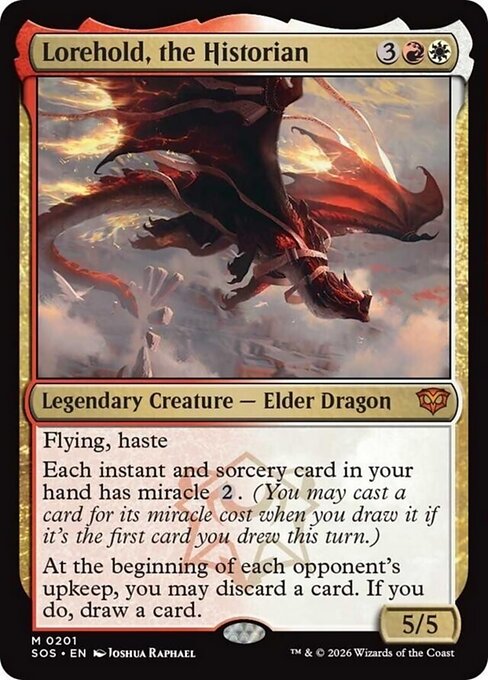
- Lorehold, the Historian — A 5/5 flying haste for five mana that gives every instant and sorcery in your hand miracle for 2 mana. Draw Moment of Reckoning off the top? Cast it for 2 instead of 7. Draw any removal spell? Cast it for 2. This Elder Dragon converts every draw step into a potential blowout. The haste means it also represents 5 flying damage the turn it lands.
- Tome Blast — Two mana to deal 2 damage at common, with flashback for five mana. Not flashy, but this is the backbone of Lorehold. Cast it early to kill a 2-toughness creature. Flash it back later to kill another one. Two removal spells from one card. And when you flash it back, it exiles from your graveyard, triggering your Spirit Mascot and similar cards.
- Aziza, Mage Tower Captain — A 2/2 for two mana that lets you tap three creatures to COPY any instant or sorcery you cast. In a deck that makes Spirit tokens, you almost always have three creatures to tap. Copy your removal, copy your card draw, copy your combat tricks. Aziza turns every spell into two spells.
- Spirit Mascot — The common mascot is a 2/2 that gets a +1/+1 counter whenever a card leaves your graveyard. Every flashback spell exiles itself, giving this a counter. If you mill yourself or exile cards from the graveyard through other means, this creature grows even faster. A 2/2 that becomes a 5/5 over the course of a normal game.
- Dig Site Inventory — One mana for a +1/+1 counter and vigilance at instant speed, with flashback for one mana. Cast it in combat to win a trade, then flash it back next turn to do it again. Two combat tricks for one card at one mana each. Lorehold's efficiency in a nutshell.
Game Plan
Lorehold is the most aggressive college. Curve out with efficient creatures: Spirit Mascot on two, a 3-drop, then start backing up your attacks with flashback spells. The key is that your graveyard IS your hand in Lorehold. By turn 5-6, you should have 2-3 spells in your graveyard ready to be flashed back, which means you effectively have a hand of 6-7 cards even if your actual hand is low.
The aggressive plan works because flashback gives you inevitability that other aggro decks lack. When a normal aggressive deck runs out of cards, it stalls. Lorehold never runs out because every spell that went to the graveyard earlier is ready for round two. Pursue the Past gaining 2 life and rummaging, then doing it again from the graveyard, is pure card advantage that keeps the aggro engine running.
Wilt in the Heat is your premium common removal — it deals 5 damage and costs 2 less if a card left your graveyard this turn. Cast a flashback spell first, then Wilt in the Heat for just 3 mana to kill almost anything. Sequencing matters in Lorehold more than any other college.
Key Synergies
- Flashback + Spirit Mascot snowball: Every flashback spell exiles from the graveyard, giving Spirit Mascot a +1/+1 counter. Cast Dig Site Inventory from hand, then flash it back — Spirit Mascot gets a counter AND you put +1/+1 and vigilance on something. Three effects from one card.
- Colossus of the Blood Age as a finisher: Colossus of the Blood Age is a 6/6 that deals 3 to each opponent on ETB and gains you 3 life. When it dies, it draws you cards. In an aggressive deck, this is your top-end: it comes down, burns the opponent, and if they manage to kill it, you refill your hand.
- Group Project token generation: Group Project creates a 2/2 Spirit for two mana, then has flashback where you tap 3 creatures. Make a Spirit, attack with your team, then flash it back using those Spirits to make another Spirit. Free creatures from your graveyard, and the original card exiling triggers your Spirit Mascot.
- Lorehold Charm flexibility: Lorehold Charm forces an opponent to sacrifice an artifact, OR returns a creature with mana value 2 or less from your graveyard, OR creates a 3/1 spirit with trample haste. The reanimation mode is surprisingly strong — get back your Aziza, Mage Tower Captain or Spirit Mascot for free and keep the value train rolling.
Quandrix (Green-Blue) — Small Creatures, Enormous Payoffs
How Increment Works
Increment puts a +1/+1 counter on a creature whenever you cast a spell whose total mana spent is greater than that creature's power or toughness (whichever is higher). The critical implication: the smaller the creature, the easier Increment triggers. A 0/3 gets a counter from any 4+ mana spell. A 1/1 gets a counter from any 2+ mana spell. This means cheap creatures are actually your best threats because they grow the fastest.

Quandrix, the Proof — 6/6 flyer with Cascade

Berta — copies spells after 3 counters
Top 5 Cards to Build Around
- Quandrix, the Proof — A 6/6 flying trample for six mana with Cascade. Cascade means you also cast a free spell with mana value less than 6. The 6/6 body dominates the air, and the free spell triggers Increment on all your smaller creatures. This card is two spells in one, and both halves are excellent.
- Growth Curve — Two mana to put a +1/+1 counter on a creature, then DOUBLE all +1/+1 counters on it. If your creature already has 2 counters from Increment, this makes it 6 counters. If it has 3, this makes it 8. This is the single most explosive uncommon in the set and the reason Quandrix can out-muscle every other college in the late game.
- Berta, Wise Extrapolator — A 1/4 with Increment. Once Berta has 3 or more +1/+1 counters, she copies the next instant or sorcery you cast. A 1/4 means any 5+ mana spell triggers Increment. After three spells, Berta starts copying your spells for free. Growth Curve to double her counters accelerates this dramatically.
- Textbook Tabulator — A 0/3 common with Increment. Because it starts at 0 power and 3 toughness, ANY spell that costs 4+ mana triggers Increment. This is your ideal turn 2 play: it blocks well early, then steadily accumulates counters until it is a 4/7 or 5/8 attacking for massive damage. The 0-power start is a feature, not a bug.
- Fractal Mascot — A 6/6 trample for six mana that taps and stuns a creature on ETB. This is your top-end common finisher. It removes a blocker, presents a 6/6 trampler, and its high mana cost triggers Increment on every smaller creature you control. Playing this on turn 6 often means your Textbook Tabulator and other Increment creatures all get a counter too.
Game Plan
Quandrix plays the opposite of Lorehold. Instead of curving out aggressively, you play cheap Increment creatures early, ramp your mana, then cast expensive spells that grow your entire board. Turn 2 Textbook Tabulator, turn 3 Studious First-Year (a 1/1 with a Rampant Growth prepare spell), turn 4 ramp spell, turn 5 Embrace the Paradox (draw 3 + put a land onto the battlefield) — and suddenly your Tabulator has 3 counters and you have drawn half your deck.
The late game belongs to Quandrix. Applied Geometry copies any permanent as a 0/0 Fractal with 6 +1/+1 counters — copy their bomb or make a 6/6 of your own. Mind into Matter draws X cards and puts a permanent onto the battlefield. These top-end spells are nearly unbeatable if the game goes long enough.
Draft ramp spells highly. Pterafractyl (an X/0 flyer with X counters that also gains 2 life) is both a threat and an Increment trigger for your other creatures. Every mana you invest pays dividends twice: once as the spell's effect and once as counters across your board.
Key Synergies
- Growth Curve + any Increment creature: Growth Curve for two mana adds a counter then doubles. On a creature with just 2 counters, that becomes 6. On a creature with 3, it becomes 8. On a creature with 5, it becomes 12. This is the single most important card to find in Quandrix — draft it over almost anything.
- Cuboid Colony flash plays: Cuboid Colony is a 1/1 flash flying trample with Increment. Play it end-of-turn, then untap and start casting spells. Because it has flying and trample with 1 power, every counter matters — a 3/3 flying trample is a real clock, and it got there by you just playing your spells normally.
- Quandrix Charm as protection: Quandrix Charm can counter a spell (unless they pay 2), destroy an enchantment, or make a creature base 4/4. The counter mode protects your threats. The 4/4 mode can either buff a small creature or shrink an opposing one. Versatile tool that answers almost any problem.
- Additive Evolution + Fractal tokens: Additive Evolution creates a 3/3 Fractal and doubles counters at combat. Combined with other counter-growers, you can create a board of 8/8s and 10/10s in a single turn cycle.
Mystical Archive — The Cards That Win Sealed Pools
Every Secrets of Strixhaven Play Booster contains a Mystical Archive card — a reprint of an iconic instant or sorcery with unique art. In sealed, these cards often define the power level of your pool. Here are the ones that matter most.
Mythic Bombs (If You Open These, You Win)
- Cyclonic Rift — Overloaded for 7 mana, this returns every nonland permanent your opponents control to their hands. There is no counterplay, no "in response." You cast this, and you win. The most powerful card in the entire Mystical Archive for sealed.
- Triumph of the Hordes — Give all your creatures +1/+1, trample, and infect. With 3-4 creatures on board, this is a one-card kill from any board state. Your opponent at 20 life? Does not matter, they need to survive 10 infect damage, and with trample they probably cannot.
- Winds of Abandon — Overloaded, this exiles every opposing creature. They get basic lands, sure, but their board is empty. Better than a board wipe because the creatures are exiled, not destroyed — no death triggers, no graveyard value.
- Force of Will — Counter any spell for free by exiling a blue card from your hand. In sealed, holding up a free counterspell for your opponent's bomb is game-winning. Even if you never pitch a card, a 5-mana hard counter is perfectly playable.
- Akroma's Will — Give your team flying, vigilance, double strike, and lifelink. This is a one-card alpha strike that ends games from almost any board state. Even the lesser mode (just double strike) is often enough to close out a game.
Best Rares (High-Impact First Picks)
- Dismember — Pay 1 mana and 4 life to give a creature -5/-5. This goes in literally any deck regardless of color. Killing a 5-toughness creature for 1 mana is absurd, and 4 life is a small price in sealed.
- Prismatic Ending — Exile any permanent with converge. In a two-color deck, this exiles anything with mana value 2 for two mana. Splash a third color and it handles 3-drops. Clean, efficient, permanent removal.
- Expressive Iteration — Look at the top 3 cards, put one in your hand and exile one to cast this turn. For two mana, this gives you card selection AND card advantage. Every blue-red deck wants this, and it is splashable in most blue or red decks.
- Sheoldred's Edict — Each opponent sacrifices a creature, planeswalker, or token of your choice. No targeting means no hexproof or protection shenanigans. Clean answer to bombs at just two mana.
Best Uncommons (You Will See These Often)
- Abrade — 3 damage to a creature or destroy an artifact. Always playable, always solid. The flexibility is what makes it special.
- Bitter Triumph — Destroy any creature or planeswalker. Discard a card or pay 3 life. Either cost is very manageable for instant-speed unconditional removal.
- Feed the Swarm — Destroy a creature or enchantment. Black rarely gets enchantment removal, making this uniquely flexible. You lose life equal to the destroyed permanent's mana value, but that is a fine price.
- Burst Lightning — 2 damage for one mana, or 4 damage kicked for five. Kills small creatures early, kills big creatures late. Premium removal at common rarity.
- Repel Calamity — Destroy a creature with power or toughness 4 or greater. Cheap, efficient answer to bombs and big threats. Does not hit small creatures, but in sealed the threats that matter are usually 4+ power.
- Giant Growth — +3/+3 for one mana at instant speed. Wins combat, saves creatures from removal, or pushes lethal damage. A classic for good reason.
- Spell Pierce — Counter a noncreature spell unless its controller pays 2. For one mana, this stops removal, planeswalkers, and combat tricks in the early game. Falls off late but the tempo swing early is enormous.
General Sealed Tips for Secrets of Strixhaven
1. Respect the Infusion Switch
When playing against Witherbloom, do not let them gain life casually. A Withering Curse without Infusion is a manageable -2/-2 to all creatures. With Infusion, it destroys everything you own. If your opponent has mana open and a life-gain source available, respect the blowout. Sometimes the correct play is to NOT attack into a Pest token, preventing them from enabling Infusion on your turn.
2. Mystical Archive Cards Define Splash Viability
Normally in sealed, splashing a third color is risky. But when your Mystical Archive rare is Cyclonic Rift or Dismember, you build around it. A single powerful Archive card can justify running 2-3 off-color sources. If you opened a bomb Archive card outside your main colors, check if your pool has fixing (dual lands, treasure makers) to support a splash.
3. Two-Color Is Almost Always Correct
Each college has such strong internal synergy that splitting across three colleges means your mechanics do not fire. A Silverquill deck with Repartee creatures and targeted spells is far stronger than a Mardu deck with scattered Repartee and Flashback cards that do not support each other. Stick to your college's two colors unless you have an overwhelmingly good reason to splash.
4. Removal Is King, But Context Matters
Harsh Annotation is the best removal spell in the format for two mana. Grapple with Death is premium in Witherbloom because it enables Infusion. Wilt in the Heat is premium in Lorehold because it gets cheaper after flashback. Evaluate removal in the context of your college — a removal spell that synergizes with your mechanic is worth more than one that does not.
5. Mascot Creatures Are Underrated
Every college's common mascot creature is quietly excellent. Inkling Mascot gains flying. Elemental Mascot becomes a 4/4 flyer. Pest Mascot grows with every life gain trigger. Spirit Mascot grows with every graveyard exile. Fractal Mascot is a 6/6 with stun. These are all premium commons that should be picked early in draft and always played in sealed.
6. Charms Are First Picks
All five college Charms — Silverquill Charm, Prismari Charm, Witherbloom Charm, Lorehold Charm, and Quandrix Charm — are premium uncommons that should be first-picked in draft. Their flexibility means they are never dead cards. In sealed, they smooth out your draws and provide answers you did not know you needed.
7. Know Your Speed
The college speeds from fastest to slowest: Lorehold (aggressive with flashback reach) > Silverquill (midrange aggro with token generation) > Witherbloom (grindy midrange with life gain) > Prismari (spell-based control) > Quandrix (ramp into massive threats). If you are Lorehold against Quandrix, you need to win before they start casting 6-mana spells. If you are Quandrix against Lorehold, you need to survive the early rush and stabilize.
Practice With Our Free Tools
Ready to put this knowledge to the test? Use our free simulators to practice before your next event:
- Sealed Simulator — Open 6 packs and build your sealed deck. Apply what you learned about college identification and mana curve.
- Draft Simulator — Draft SOS against AI opponents. Practice reading signals and committing to a college at the right time.
- Draft Tier List — Check our card-by-card ratings to see how we evaluate every card in the set for limited.
- Booster Simulator — Crack virtual packs and familiarize yourself with the cards before sitting down for a real event.
Good luck at your next Secrets of Strixhaven event. May your Repartee always trigger, your Infusion always be active, and your Opus spells always cost 5 or more.